
The free-entry era ended in July 2023, and the price moved again on 1 July 2026. Half the advice online still tells you to wander in off the piazza. So people arrive expecting an open door and find hourly slots and a name printed on the ticket that has to match their passport.
I visit Rome every year and re-read the Ministry of Culture’s own pages before every trip, because the Pantheon Rome rules have changed twice in three years.
Four things you will not get from a ticket-listing page: how the slot system behaves when a date fills up, which hour makes the light worth standing still for, what to look at that is not the dome, and which coffee nearby is worth the walk. If you are still shaping the trip, the 3-day itinerary shows where this fits.
Visit in Brief: Hours, Tickets and Getting There
- Hours: 09:00 to 19:00 daily. Ticket office closes 18:00, last individual entry 18:30, groups 18:00.
- August evenings: 19:00 to 23:00 daily except Thursdays. No tour groups, no daylight heat.
- Closed: 25 December and 1 January, aside from extraordinary openings.
- Ticket: 7 euros full, 2 euros reduced for EU citizens 18 to 25. Free for under-18s, Rome residents, licensed guides and EU school groups.
- Free entry: first Sunday of every month, on site only, no online booking that day.
- Booking: Musei Italiani portal or app, or the ticket office by cash or card. Recommended to guarantee a slot; walk-up is possible but not guaranteed.
- Mass: Saturday and pre-holiday 17:00, Sunday and holidays 10:30. Sales stop an hour before any liturgical activity.
- Nearest transport: no metro at the door; it sits in a pedestrian zone, so you arrive on foot. Closest metro: Spagna or Barberini (line A), then walk. Buses: Largo di Torre Argentina (30, 40, 46, 62) or Via del Corso (51, 62, 63, 83).
- Time needed: 30 to 45 minutes. My call, not an official figure.
How Pantheon Tickets Actually Work in 2026
You book a ticket for your partner, their name goes on it, and at the door someone checks it against a passport. Or you remember the Pantheon as the free one, walk up on a June Saturday, and every slot is gone.
What you pay. Full price is 7 euros, up from 5 on 1 July 2026, under an agreement between Italy’s Ministry of Culture and the Diocese of Rome signed 10 April 2026. A page still headlining 5 euros has not been updated since June 2026; one saying free has not been touched since 2023. Reduced is 2 euros for EU citizens 18 to 25, and under-18s go free.
The slot system. Nine hourly slots a day, from 09:00 to 10:00 through to 17:00 to 18:00. Reseller sites say ten. It is nine. Each admits a maximum of 1,200 people per hourly slot, not per day, the number nearly every other page gets wrong. Across nine slots the ceiling is nearer 10,800, so the building never feels capped, but a slot on a peak date does sell out.
Booking, with an honest caveat. Tickets sell through the Musei Italiani portal, the app, or the ticket office by cash or card. Two official Ministry of Culture pages contradict each other: one describes slot-based access until availability runs out, the other calls reservation optional and visits first-come, first-served. Since they disagree, book. A reservation is how you guarantee a slot; walk-up is possible but not guaranteed. Whether a city pass changes the maths is a separate question.
Your ticket has a name on it. It is nominal and must match the government ID you present. One change is permitted up to 72 hours before your booked slot. Book in the name of whoever walks through the door.
Free Sundays. The first Sunday of the month is free, and nothing is bookable online that day. You queue on site for a non-nominated ticket on one of the month’s busiest days. Pay the 7 euros unless the budget is tight.
Visiting April to October? Book when the calendar drops. Off-season, walk up before 10:00.
In September 2025 my queue took about 15 minutes, all of it in the sun. Walking past on another day, the line was a lot longer, so treat mine as the good draw, not the promise. And the ID-matched ticket in practice: nobody really studied my passport, but they did give my attire a good look.
The Best Time to Visit the Pantheon: Light, Crowds and Mass
Three variables decide whether your visit is memorable or forgettable, and all three are published in advance. Nobody puts them together. The same building at 09:15 and 12:30 is effectively two different rooms.
Mass is a hard constraint. Services run Saturday and pre-holiday at 17:00, Sunday and holidays at 10:30, and ticket sales stop one hour before any liturgical activity. On a Sunday that halts sales from 09:30, which squeezes the morning slots badly. Entry during Mass is free for those attending worship, but sightseeing access is restricted. This is a working basilica with a monument inside it, not the reverse.
Crowds. No official source publishes hourly footfall, so treat the usual 11:00 to 14:00 crush as a pattern, not a number. The per-slot cap means the rotunda never returns to its pre-2023 density, but a full slot still feels full. Good windows: the 09:00 slot, and the last hour before 18:30. In August, the 19:00 to 23:00 evening opening (closed Thursdays) is the quietest hour of the year.
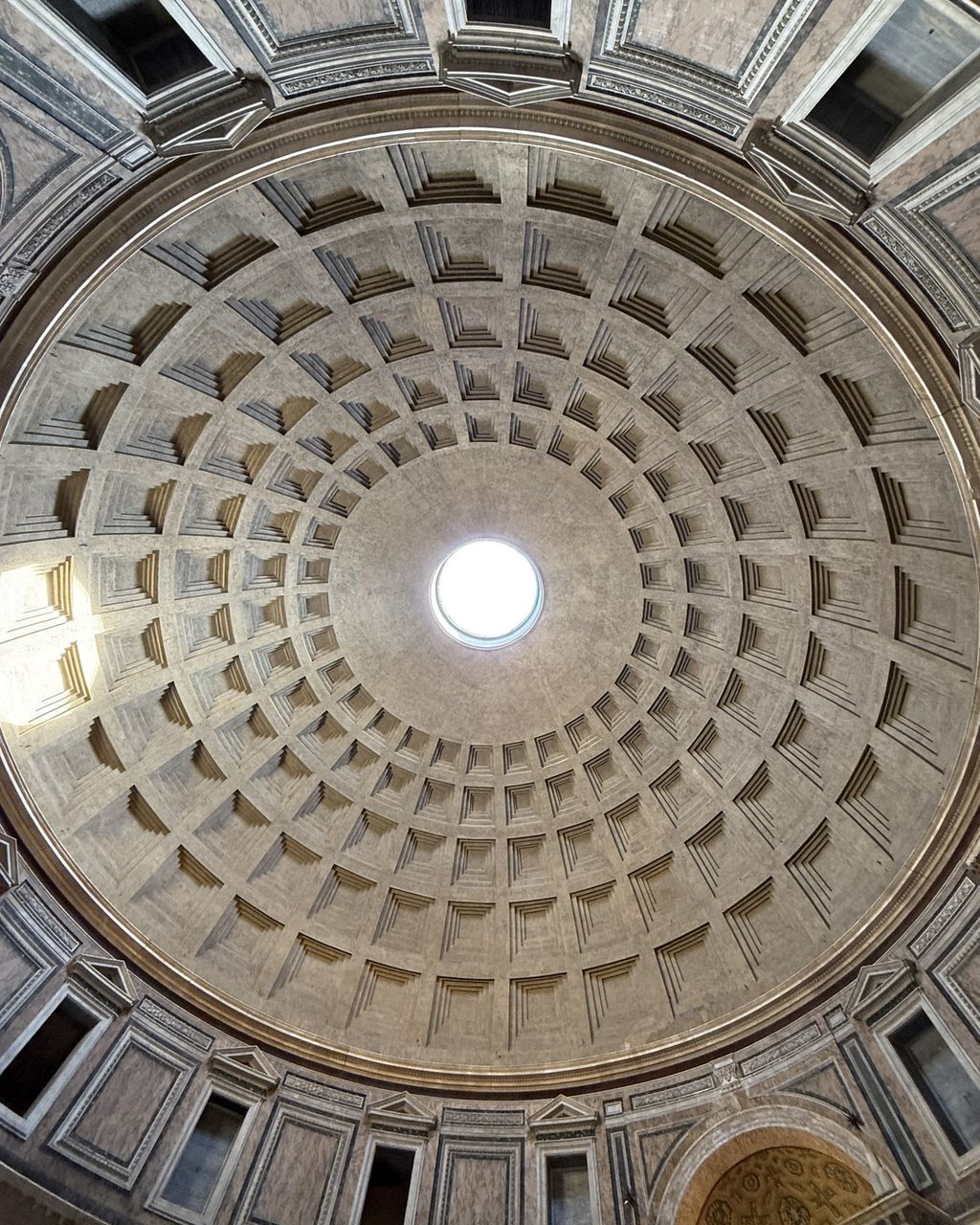
Light is why the hour matters. On a sunny day the oculus throws a disc of light that tracks across the coffered dome, down the wall and onto the floor. Highest and hardest near midday, longer and warmer late. An overcast day gives you the building without the effect. This is the one monument in Rome where the forecast should change your plan.
Rain is underrated. The oculus is open, so rain falls into the rotunda and drains away through the sloped marble floor. Most visitors flee. A rainy Pantheon beats a grey one.
Forced to choose between 09:00 and midday, take 09:00. The midday beam is stronger, but you share it with the fullest slot of the day, and an empty rotunda beats a better photograph.
The Oculus: What the Light Actually Does
Italy’s Ministry of Culture calls it one of the first special effects in history. Fair, and also a setup: the alignment behind that phrase happens one day a year. What you will see is quieter and, on the right afternoon, better.
Every clear day. The disc of sunlight rewards ten minutes of standing still more than a photograph.
21 April. At noon on Rome’s traditional founding date, the sun enters the oculus at an inclination that throws a beam centring precisely on the entrance portal. That is the Ministry of Culture’s own 2026 account: the emperor would cross the threshold at that hour so his whole figure sat inside the light. The Ministry ran a guided visit that day, “Magia di luce: il Pantheon e la fondazione di Roma”. Weather-dependent and crowded, so plan around it only if you are in Rome anyway.
Pentecost. After the Mass, firefighters release thousands of red rose petals through the oculus, symbolising the descent of the Holy Spirit. A long-documented tradition on a movable date roughly 50 days after Easter. Check the basilica’s announcements for timing.
How big is it? Roughly nine metres across, and I say roughly on purpose: published figures run from 8.8 to 9.2 and no primary source pins it down. The dome spans approximately 43.3m. The oculus figure differs on almost every page you read, which tells you how much got copied without checking.
You do not need 21 April. You need a clear sky and the patience to stand under it.
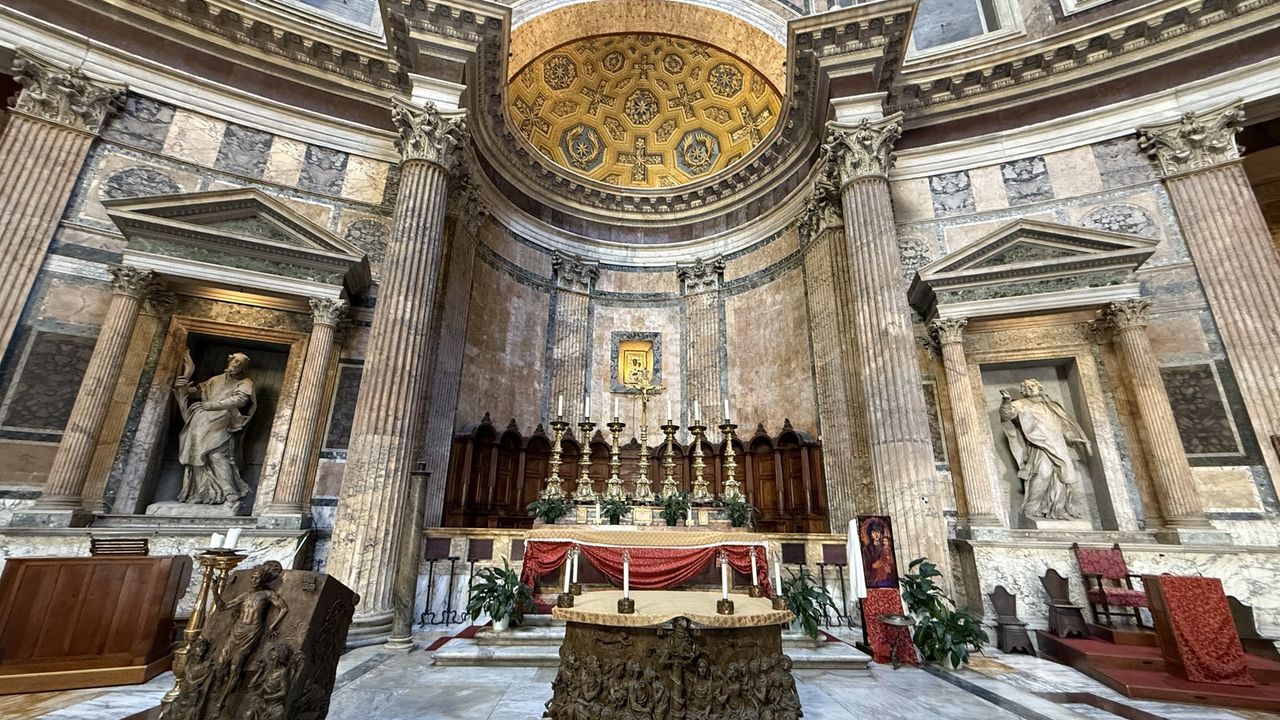
What To Actually Look At Once You Are Inside
The ten-minute walk-through is why people call this place underwhelming. Five things make it worth twenty-five, in the order your feet meet them.
The portico and the bronze doors
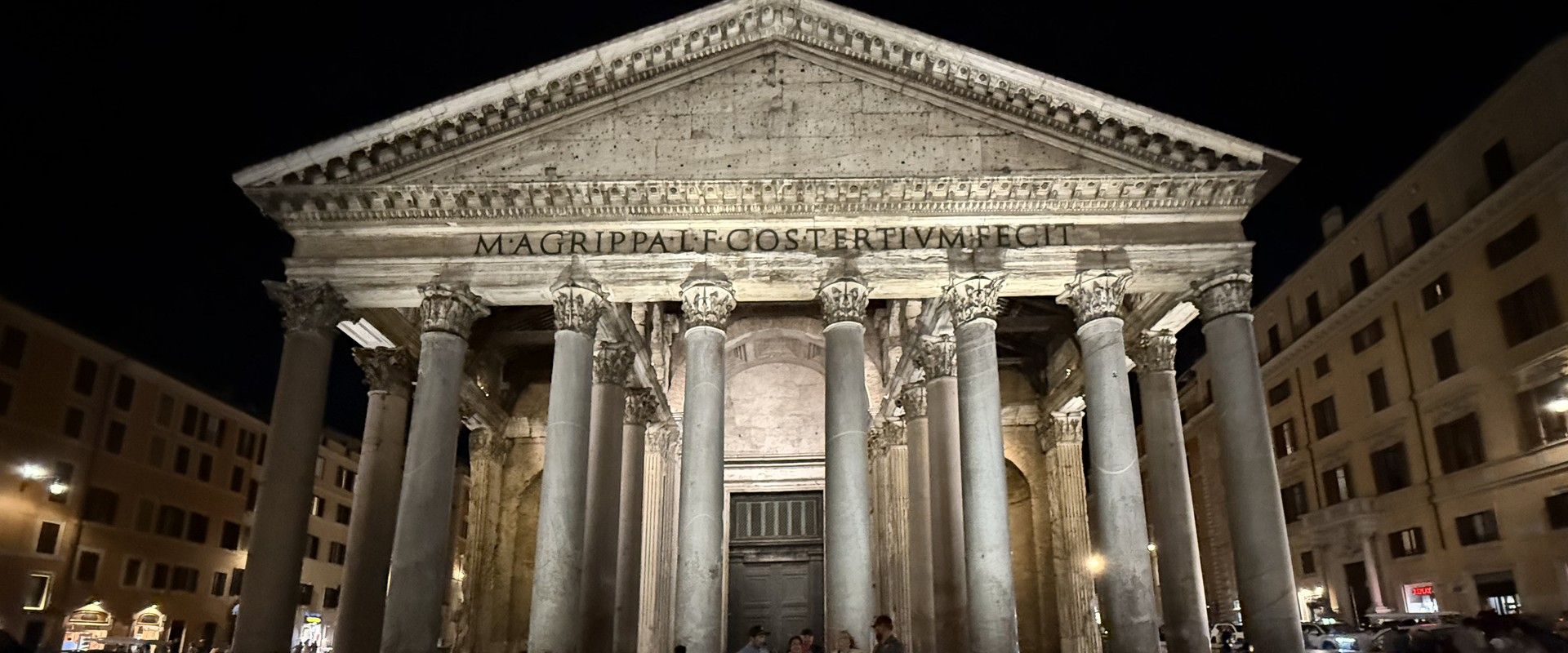
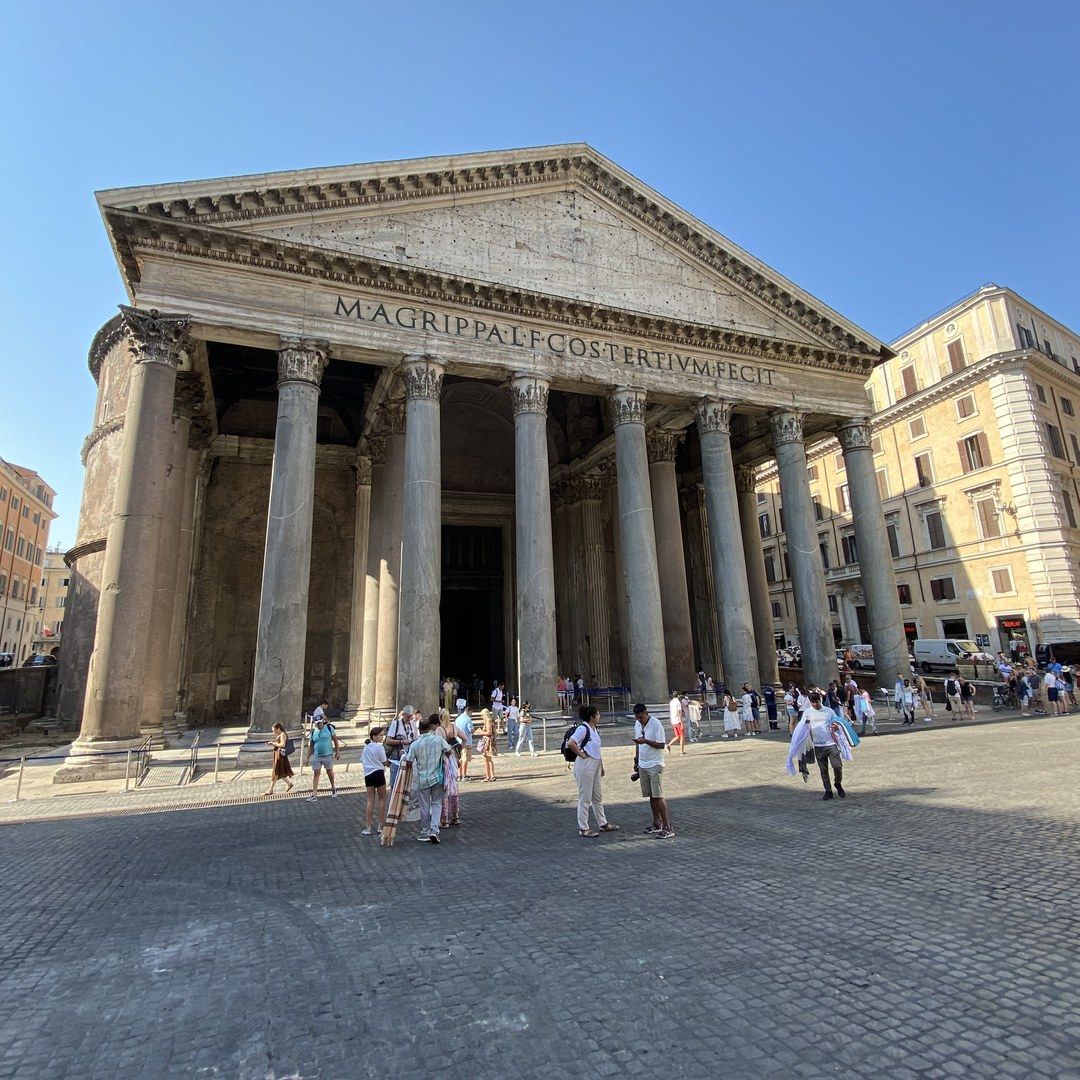
Sixteen granite columns, then the doors, among the largest surviving from Roman antiquity: 7.53 by 4.90 metres, the figure the basilica’s own channel quotes. Stop under the portico first. It is the easiest part of the building to walk straight through.
The dome and its coffering
Approximately 43.3m across, historically the largest dome built until modern times. The coffers are structural weight-saving, not decoration, and the concrete gets lighter the higher it goes. Which is why it is still standing.
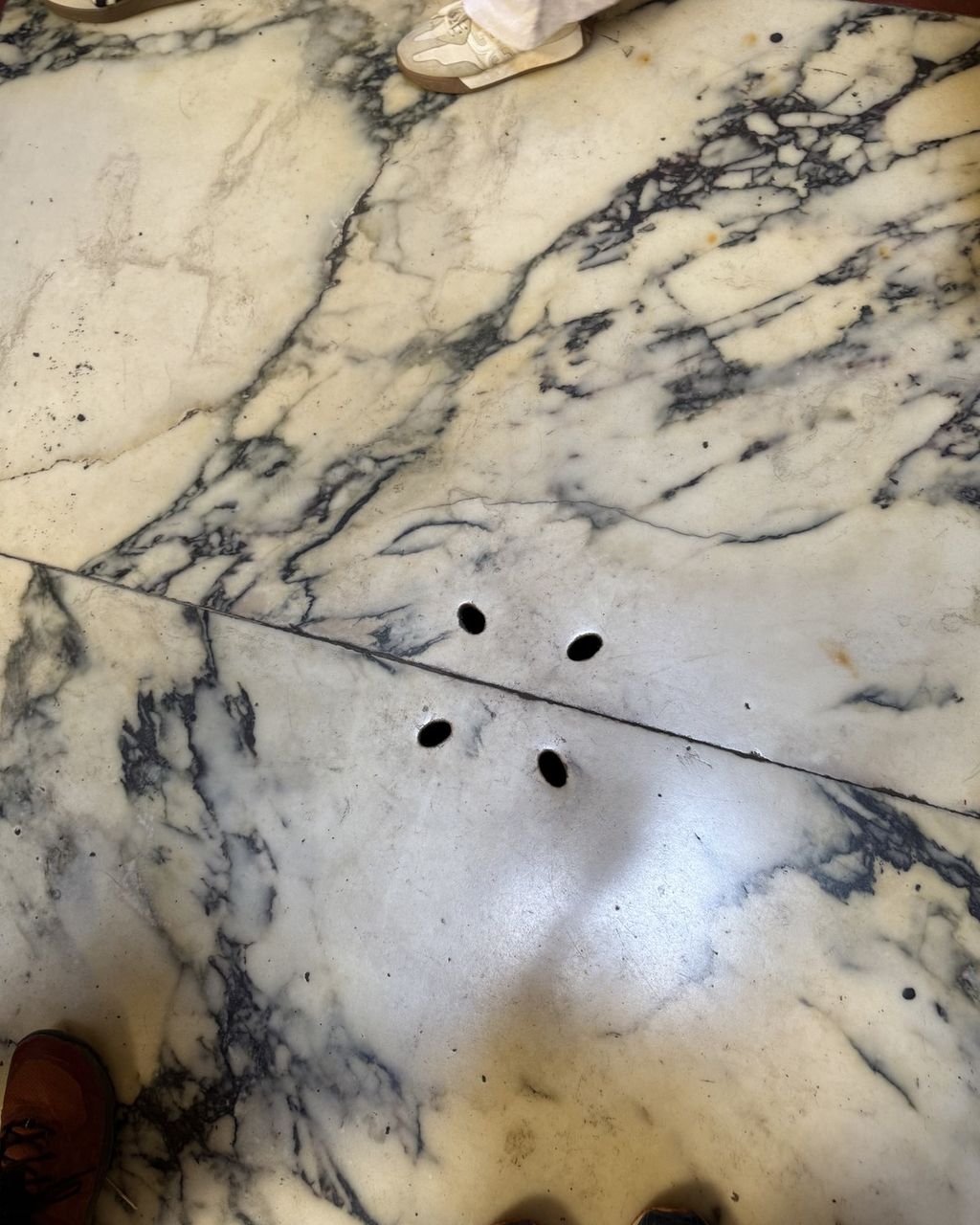
The floor, which nobody looks at
The marble floor is subtly domed and sloped, with small drainage holes carrying rainwater out of the building. Original Roman engineering, not a retrofit. Look down and find them.
Raphael’s tomb
Raphael is buried here, in a niche as you work around the rotunda. Easy to walk past.
The two kings
Vittorio Emanuele II and Umberto I, Italy’s first two kings, are entombed here. A Roman temple that became a Christian church is why the building survived intact while imperial Rome was quarried, and that status made it a resting place for a new nation.
Renting the audio guide means leaving an original physical ID (passport, driving licence or ID card) at the Roma Museum Store, Via dei Bergamaschi 49. A photocopy or phone photo is not accepted. I have never used it, so I will not pretend to review it; the ID deposit alone tells you it is built for people with time. Short on time, skip it.
Five Things Guides Get Wrong About the Pantheon
The rules have changed twice since 2023 and most travel content has not caught up.
1. “The Pantheon is free.” It was, until July 2023. Full price is now 7 euros, raised from 5 on 1 July 2026. The real exceptions are narrower than the myth: the first Sunday of every month, and during Mass for those attending worship.
2. “There is a 1,200-person daily cap.” The most misread number in Pantheon content, usually quoted without saying per what. The official figure is 1,200 people per hourly slot. With nine slots, the ceiling is nearer 10,800.
3. “Tripods are banned and flash is prohibited.” This traces to reseller sites, not the monument. The official rules permit personal photography and video and prohibit professional shooting without authorisation from the Direzione dei Musei statali della città di Roma. Tripods and flash are not mentioned either way, though staff at Italian state sites commonly discourage both.
4. “It is a quick ten-minute stop.” Give it 30 to 45 minutes and the five things above, and it stops being a photo you took on the way to lunch.
5. “The light beam happens whenever it is sunny.” The moving disc does. The beam centring on the entrance portal is a noon, 21 April phenomenon. Do not book a Tuesday in June expecting the postcard.
Check the date on any Pantheon page you read. If it does not name its source, assume the price is stale. The same instinct pays off across the rest of the city.
The Rules That Actually Get People Turned Away
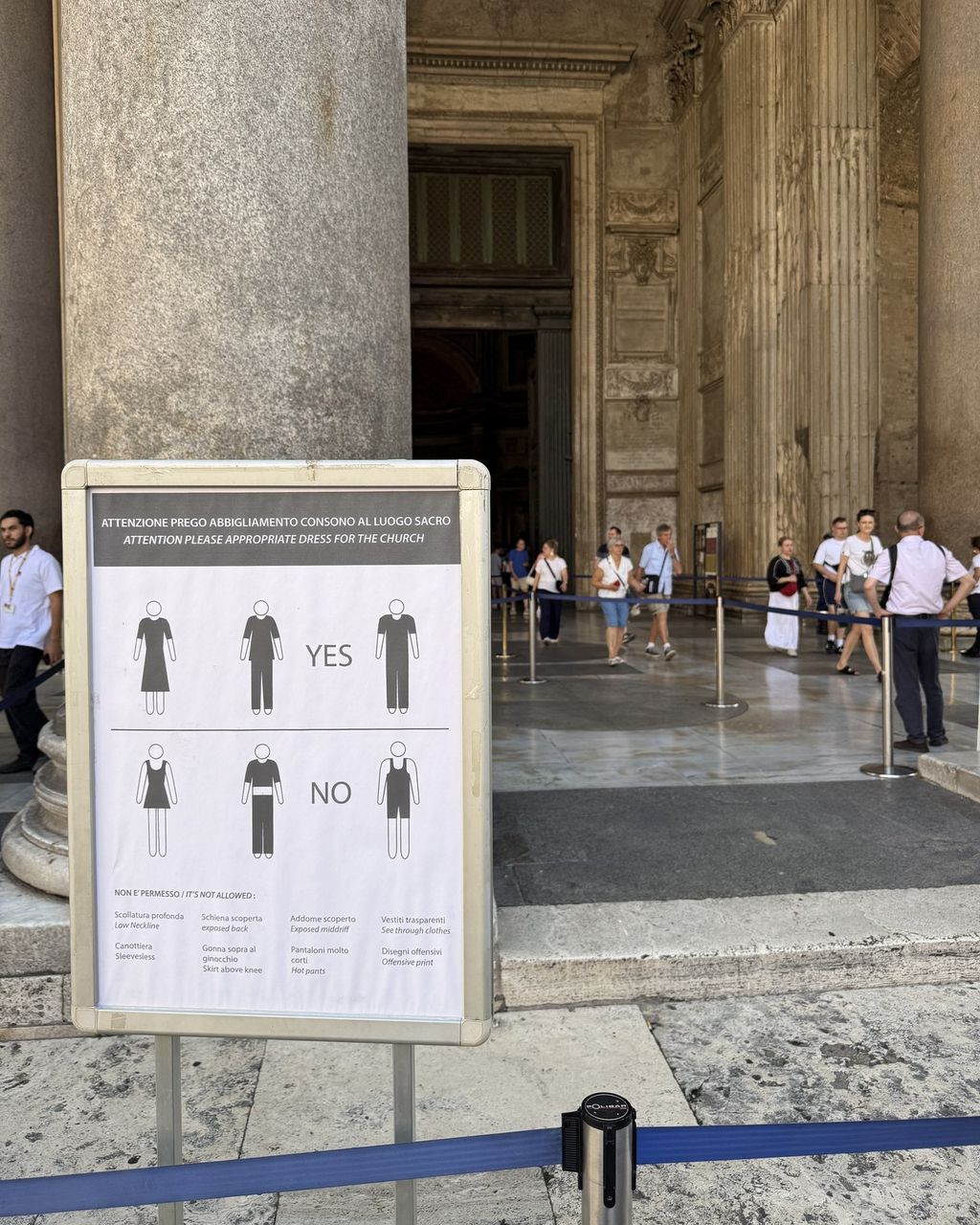
You have the booked slot, you queued, and someone stops you at the door over a vest top. Summer catches people out, because summer is when nobody packs sleeves.
The official wording. Shorts or skirts that are too short and excessively low-cut clothing are not permitted, shoulders must be covered, transparent garments avoided. Plainly: shoulders covered, nothing above mid-thigh, nothing see-through.
Enforcement. Visitors report guards checking attire and refusing entry. Expect enforcement, and do not assume leniency either way. Vendors near the entrance sell and rent cover-ups, a fix costing money and time you need not have spent.
Photography and behaviour. Personal photos and video are fine. Professional shooting needs authorisation from the Direzione dei Musei statali della città di Roma, and phones are for pictures, not calls. Working basilica, so keep your voice down.
Mass. Sales stop an hour before any liturgical activity, so arriving at 09:45 on a Sunday means no ticket.
June to September, keep a scarf or linen overshirt in your bag. The Rome-wide version is in the church dress code guide.
Coffee and Food Near the Pantheon Worth Your Money
The tables directly on Piazza della Rotonda are paying for the view, and you are paying for their view. Walk two or three streets off the piazza and prices drop by roughly a third. My rule, not a published statistic.
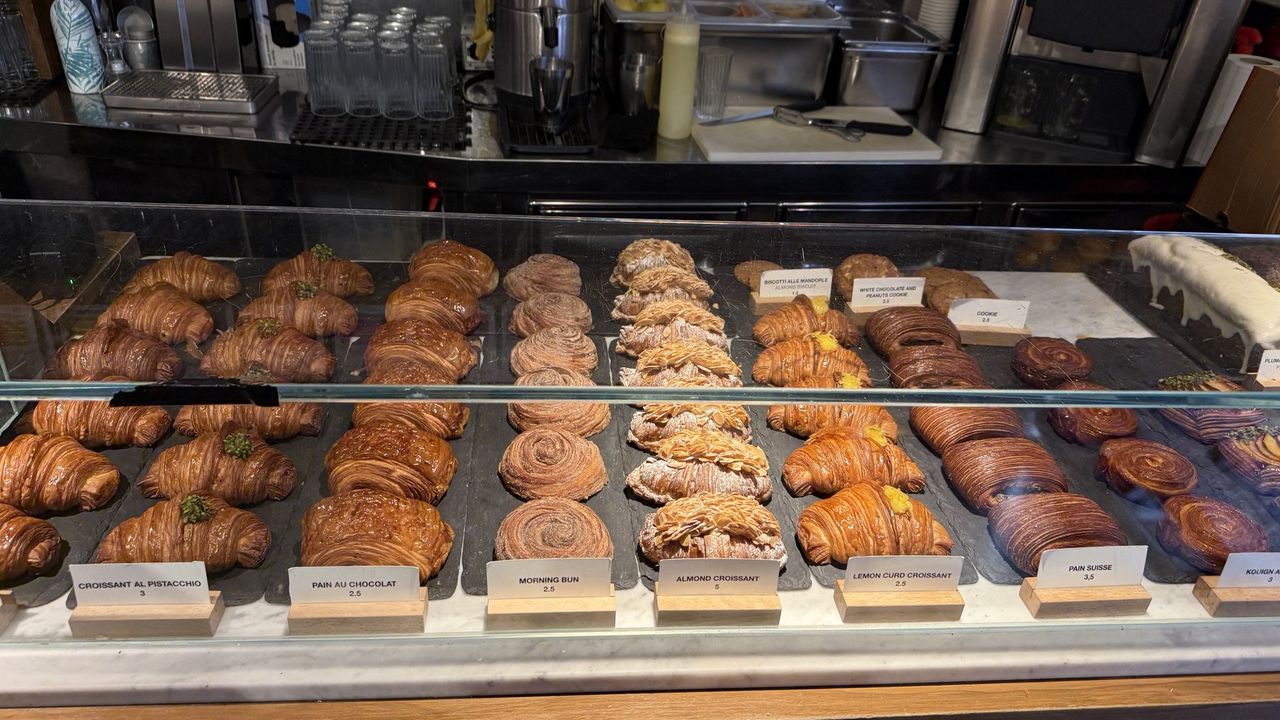
Barnum Cafe. Cappuccino and, of course, a cornetto stuffed with pistachio: once at a table, once standing at the counter the way the locals do it. The pastry case is fresh and crispier than anything I get at home. It is a proper walk rather than a step around the corner, so treat it as a destination.
Sant’Ignazio. Not food, but the natural next stop: the trompe-l’oeil ceiling is a few minutes away and free to walk into.
The famous coffee bars. Sant’Eustachio, Tazza d’Oro and Giolitti get name-dropped as musts on every Pantheon page going. I have not been to Sant’Eustachio, so I am not going to tell you it is the best coffee in Rome the way everyone else does. All three draw queues at peak hours. Read where Romans eat before committing to dinner nearby.